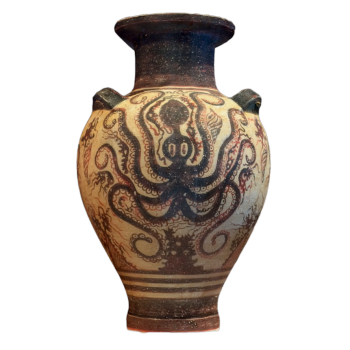
Minoan vase

Minoan vase

The Minoan vase is a ceramic artwork from the Minoan period of ancient Greek civilization, which existed approximately between 2600 BC and 1100 BC. The Minoan civilization is one of the earliest civilizations in ancient Greece, mainly located on the island of Crete and later on the Greek mainland. The Minoan vase is an important symbol of cultural and artistic achievements during this period. The Minoan vase is renowned for its exquisite craftsmanship and decoration. They usually have smooth lines and elegant forms, decorated with complex geometric patterns, marine creatures, plants, and mythological scenes.
Bonn University Academic Art Museum Ancient Greek Pottery

Bonn University Academic Art Museum Ancient Greek Pottery

A piece of ancient Greek pottery collected in the Academic Art Museum of Bonn University. This bowl is said to have been discovered at the Diplon Gate in Athens, around 750 BC to 735 BC, and was produced in the Attica region. This vessel is characterized by steep edges and a horizontal band like handle. The upper wall is divided into panels with stars, Capricorn, swastika, and checkerboard patterns. The wide stripes between the handles are divided into three panels: a display zigzag band in the middle and birds on both sides. The handle itself is also decorated with a zigzag band. It is an outstanding representative of ancient Greek pottery art and an important physical evidence for studying ancient Greek culture and artistic style
Prototype Geometric Lequitos Bottle

Prototype Geometric Lequitos Bottle

It is an ancient Greek pottery, collected in the Academic Art Museum of Bonn University. This Lechitos bottle can be traced back to the prototype geometry period of the 9th century BC and was made in the Athens region. Known for its simple geometric patterns and decorative style, these patterns typically include lines, circles, and simple shapes. As a typical representative of this period, it showcases the skills and artistic aesthetics of ancient Greek ceramic artists. These pottery bottles are not only practical containers, but also valuable materials for studying ancient Greek culture and religious customs.
Saint Valentine's Cup

Saint Valentine's Cup

It is an ancient Greek pottery cup collected by the Academic Art Museum of Bonn University, dating back to the late 5th century BC or early 4th century BC. Belonging to the so-called Saint Valentine Cantalos Cup category, it is characterized by a bell shaped body and a vertically installed handle that connects the rim of the cup to the lower part of the cup body. It may have been produced based on the prototype of Attica in Attica or Apulia region. Each side has decorative panels, with Ionic vortex patterns on the upper and lower edges, and the middle area filled with laurel and ivy wreaths and dotted lines. It showcases the exquisite craftsmanship of ancient Greek pottery and reflects the aesthetic style of the time.
Ancient Greek black painted narrow necked pottery jar

Ancient Greek black painted narrow necked pottery jar

Made around 540 BC, it is a ceramic artwork from the Attica region of ancient Greece. This pottery jar is characterized by black painting techniques and is jointly completed by potters and painters. The black painting technique involves using black pigment to depict images on pottery, then carving details and applying clear paint to create a sharp contrast during the firing process. Usually between 47 and 61 centimeters in height, its surface is painted with mythological scenes, war scenes, or sports competition patterns. Not only for practical purposes such as storing wine or olive oil, but also as an important medium for showcasing the cultural and artistic achievements of ancient Greece.
Sculpture of the discus thrower

Sculpture of the discus thrower

It is a famous sculpture created by the ancient Greek sculptor Myron in the 5th century BC. Although the original work is lost, through replicas from the Roman period, we can glimpse the charm of this artistic masterpiece. This work depicts the moment when an athlete throws a discus, showcasing the perfect combination of strength and beauty. Athletes are naked, with clear muscle lines and leaning forward, in a tense and dynamic posture, reflecting ancient Greece's pursuit of human beauty and dynamic beauty. It is a model of ancient Greek sculpture art and has had a profound influence on artists in later generations.
Farnagoria Science Center

Farnagoria Science Center

An institution dedicated to studying the archaeological sites and historical cultural heritage of the ancient Greek city of Farnagoria in the Black Sea region of northern Russia. It is one of the largest cities in ancient Greece in the North Black Sea region, and its ruins cover a large area that has not yet been modernized and developed, which is of great significance for scientific research. It may involve interdisciplinary research work, including archaeological excavations, historical literature research, cultural relic protection and restoration, etc. Through its research, the aim is to reveal the development, cultural characteristics, and exchanges with other ancient civilizations in the region. It is of great value for understanding the history, culture, and economic exchanges of the ancient world.
Ceramic vase with sacrificial patterns from 420 BC

Ceramic vase with sacrificial patterns from 420 BC

Discoboluslancellotti discus thrower ancient Greek statue

Discoboluslancellotti discus thrower ancient Greek statue

Discobolus lancellotti is an ancient Greek statue depicting an athlete throwing a discus. This statue is believed to have been replicated based on the work of the ancient Greek sculptor Mirto, 'The discus thrower'. A young athlete was showcased, elegantly poised to throw a discus. The body lines and muscles of the statue are accurately sculpted, showcasing the release of his power and the dynamics of his movements. This statue is renowned for its exquisite artistic skills and accurate expression of human proportions. It is one of the important representatives of ancient Greek sculpture art.
Ancient Greek vase painting pottery with double ears, long neck, high vase

Ancient Greek vase painting pottery with double ears, long neck, high vase

World's top art sculpture, broken arm Venus plaster statue

World's top art sculpture, broken arm Venus plaster statue

The Venus de Milos, also known as the "Broken Arm Venus", was discovered on Milos Island in 1820 and immediately caused a sensation throughout Europe. It was contested by several countries and the arms of the sculpture were unfortunately destroyed during the chaos. After many twists and turns, it was finally purchased by France as a birthday gift to King Louis XVIII of France, who then gave it to the Louvre. Venus also became a broken arm goddess from then on. However, the lost arms instead interpret a flawed beauty.
Poseidon, the ancient Greek sea king, is depicted in blue bronze with a full body

Poseidon, the ancient Greek sea king, is depicted in blue bronze with a full body

Poseidon (Greek: ∋οσειδῶν, English: Poseidon) is a Greek mythological sea god and one of the twelve Olympian gods. He was also the god in charge of horses. Legend has it that he gave humans the first horse, which was a golden chariot driven by a white horse. He was the brother of Zeus and Hades. Poseidon's image is usually described as a strong man wearing a sea god robe, holding a trident. He is in charge of the ocean, waves, marine life, and navigation, possessing strong power and the ability to control the ocean.
Marble bust of the ancient Greek god Hercules

Marble bust of the ancient Greek god Hercules

Hercules (Ancient Greek: Ἡρακλῆς, Modern Greek: Iraklis, English: Heracles, also translated as Heracles, Heracles, Hercules, Hercules) is the greatest hero and demigod in ancient Greek mythology. After birth, he was initially named Alcides. The son of King Zeus and Alcmene, born with infinite strength.
Ancient Greek Antique Bronze Art Binaural Vase
Ancient Greek Antique Bronze Art Binaural Vase

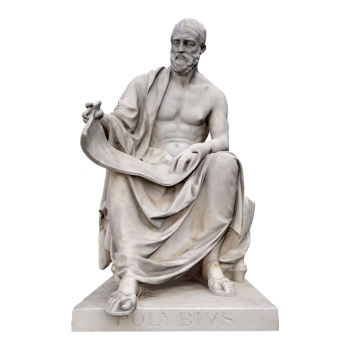
Marble statue of the Austrian Parliament building Polybios

Marble statue of the Austrian Parliament building Polybios

Polybius (Polybios) It was created in 1899 by the Austrian sculptor Alois Düll, carved from marble. It is in honor of the ancient Greek historian Polybios, best known for his major work "History", which originally had 40 volumes and described the universal history of Rome from the beginning of the First Punic War to the destruction of Carthage and Corinth.
Bronze statue of LaOCon and his sons

Bronze statue of LaOCon and his sons
This is an ancient Greek sculpture depicting the tragic scene of Troy temple priest Laocon and his two sons in the midst of being entangled by poisonous snakes.
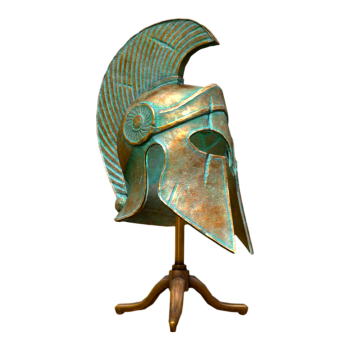
Collins Helmet 3D Model

Collins Helmet 3D Model

The thickness of the Corinthian helmet varies depending on the location. The thickness of the skull part is about 0.25cm, and the facial part such as the nose is extremely thick, some even reaching 0.6cm. The helmet is decorated with a horsehair pattern and a horsetail trailing behind it. A soldier wearing this helmet means he is as energetic as a horse. The splicing method of this horsehair decoration also varies from place to place. Generally, a small groove or angle hook is made on the top of the helmet, so that it is convenient to install or remove decorations at will. The "horsehair" is generally vertical, but Sparta, which likes to be on its own, is horizontal.
Ancient Greek Pottery 3D Model

Ancient Greek Pottery 3D Model
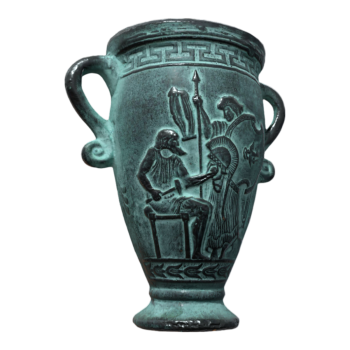
Imitation Minoan civilization bronze 3D model

Imitation Minoan civilization bronze 3D model

"Minoan civilization (Minoan Civilization/The Minoans)" is also translated as Minoan civilization. It appeared in ancient Greece and the Bronze Age before Mycenaean civilization, about 2850 BC -1450 BC. It is the earliest ancient civilization in Europe, but also the precursor of the Greek classical civilization. It is famous for its exquisite palace buildings, murals, pottery and handicrafts.
Ancient Greek Pottery 3D Model

Ancient Greek Pottery 3D Model

Ancient Greek Pottery Bottle 3D Model

Ancient Greek Pottery Bottle 3D Model